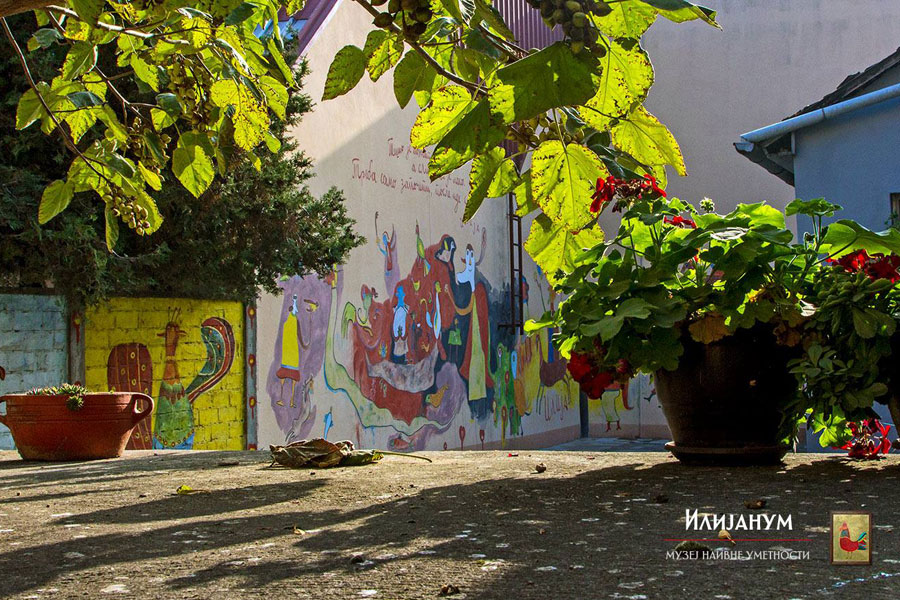
Svetog Save 5, 22240 Šid, Serbia

Ilijanum is at Svetog Save 5, 22240 Šid. The published individual admission is 100 RSD. Regular opening is Monday–Friday 08:00–18:00 and Saturday 09:00–15:00; Sunday access is limited to pre-arranged group visits. Regular individual visits do not require a reservation. Expert-guided and organised group visits require prior notice, and groups should contact the museum at least three days ahead.
In Šid’s cultural landscape, Ilijanum has a clearly defined identity: its name honours Ilija Bašičević Bosilj, and its collection preserves his artistic legacy alongside works by other Serbian and international naïve and marginal artists. It is not the town’s separate Sava Šumanović Gallery, and it is not the public gallery associated with Kovačica’s painters. That distinction matters because each institution presents a different artist, collection history, and visual tradition. Ilijanum gives cultural travellers a focused western-Serbian stop within Vojvodina’s wider cultural landscape, rather than a general survey of the town’s museums.

A Bosilj figure can face in two directions at once. The duplicated heads are not a conventional exercise in portraiture or perspective; they belong to a symbolic pictorial space in which several identities, viewpoints, or states can coexist. The municipal interpretation connects this visual language with layered meaning, but it should not become a fixed formula applied identically to every painting.
Start by examining how the faces relate to the body. Notice whether they mirror one another, diverge, or share a single outline. Then look at nearby animals, birds, emblems, and colour fields. Bosilj’s imagined worlds are easier to read when a figure is treated as part of a relationship rather than decoded as an isolated symbol. Ambiguity is part of the encounter, not a detail that has to be resolved.
Ilija Bašičević Bosilj began painting late in life after working as a farmer. His first painting is dated to 1957, a useful point of orientation because it places the beginning of his artistic work outside a conventional academy-to-studio career. He was self-taught, but that description should not be mistaken for an absence of structure. His pictures developed recurring cycles, figures, animals, signs, and ways of arranging space.
The late start is biographically significant without serving as a complete explanation for the art. It does not establish a hidden psychological key, nor does it make every work a direct record of rural life. For visitors, the practical consequence is to look for repeated visual decisions across different subjects. The continuity between a biblical scene, an epic figure, and a hybrid creature often lies in Bosilj’s pictorial grammar rather than in their narrative setting.
Bosilj’s documented themes include biblical narratives and imagery associated with the Apocalypse. He does not approach these subjects as an illustrator reconstructing architecture, clothing, or landscape with historical precision. Sacred figures enter the same symbolic space as his doubled faces, animals, signs, and flattened fields of colour.
When a biblical subject is on display, begin with what is visually present before searching for a complete narrative sequence. A frontal figure, repeated eye, compressed group, or animal companion may carry as much weight as the nominal episode. This method keeps interpretation tied to the painting while allowing the religious source material to remain one layer among several. The museum’s holdings should not be taken as a promise that a complete biblical or Apocalypse cycle will be visible together.

The Ilijada cycle brings epic subject matter into Bosilj’s personal system of heroes, creatures, signs, and non-naturalistic space. Its figures may suggest conflict, authority, encounter, or procession, but the pictures are not documentary reconstructions of a particular battle or historical period. Epic material acts as a framework through which Bosilj can arrange identities and forces in relation to one another.
Look for hierarchy without assuming that physical size settles it. A smaller bird or animal may command attention through position, repeated pattern, or direct eye contact. Likewise, a two-faced hero can hold several roles at once. The cycle is most useful as a named body of work within the artist’s practice, not as permission to attach an exact story to every unfamiliar scene.
Birds and animals recur strongly enough in Bosilj’s work to form documented collection themes, including Birds and Animals and Flying. They occupy the pictorial field as participants. Some stand beside human figures; others combine animal, human, and invented features so that familiar categories become unstable.
A useful viewing sequence begins with form rather than species. Follow the outline, count repeated heads or limbs, and see whether wings belong to a recognisable bird or to a hybrid being. Then examine the creature’s relationship to nearby figures. Scale and anatomy need not follow ordinary observation because Bosilj’s space is symbolic. This approach avoids reducing the animals to decoration while leaving room for uncertainty where a title or gallery label does not settle the subject.

The collection profile lists oils on glass and hardboard, as well as gouaches and drawings. Those supports affect how a picture is encountered. Glass creates a materially different painted object from absorbent board or paper, while drawing exposes line and structure without relying on the same density of painted colour. Check the label for medium before assuming that similar imagery was made by the same process.
Ilijanum also preserves work by other Serbian and international naïve and marginal artists. Bosilj remains the defining figure, but the wider collection allows visitors to notice how individual artists handle narrative, contour, material, and imagined space differently. Holdings are not a guarantee of what is installed on a given day. Travellers developing a broader Serbian art route can place Ilijanum alongside the Museum of Naive and Marginal Art in Jagodina, while treating the two museums as separate institutions with distinct collections.
Ilijanum rewards a focused visit because its central question is not how many Šid landmarks can be covered in sequence, but how Bosilj built a visual language across different subjects. The separate Sava Šumanović Gallery concerns another artist and collection. Kovačica’s public gallery belongs to another local tradition. Treating all three as interchangeable examples of naïve art would obscure the distinctions that make each collection legible.
Šid lies in western Vojvodina, away from the denser museum circuit described in Novi Sad’s museums and historic centre. That makes advance confirmation sensible, particularly when travelling for a specific cycle or arranging an expert-guided visit. Once inside Ilijanum, choose two or three recurring motifs and follow them across the available works. The result is a more coherent encounter than attempting to attach a definitive meaning to every figure.
Use Svetog Save 5, 22240 Šid as the destination. Šid railway station is served by Serbia’s railway line 101, the Belgrade Center–Šid–state-border corridor. A numbered urban bus connection from the station to Ilijanum is not published in the museum visitor information, and Šid has no tram or trolleybus network.
A verified walking route, walking time from the station, and nearest named landmark are not published, so check the current map before setting out rather than relying on an assumed town-centre route. A typical local taxi fare is also not published; confirm the fare with the driver before departure. Dedicated museum parking arrangements are not stated. Visitors continuing around the country can use the guide to getting around Serbia by train, bus and taxi for general ticketing and transport practice.
A regular visit covers the permanent exhibition and exhibition halls, presenting Bosilj’s legacy together with the museum’s wider naïve and marginal art collection. Expert-guided touring is available with prior notice. Organised groups should make contact at least three days ahead, and a Sunday group visit must be arranged in advance. A published tour duration, fixed number of works, and guided-tour surcharge are not available.
Arrange a guided visit through Ilijanum’s official visitor site, by calling the museum, or by emailing the Ilijanum team. A second published telephone contact is available through the museum’s additional phone line.
No special dress code or age restriction is published. Detailed information about step-free entry, accessible toilets, seating, photography, large bags, and assistance for visitors with sensory needs is not published either. Contact the museum before travelling if any of these conditions will determine whether the visit is workable. Families can visit, but no dedicated children’s programme or family trail is confirmed. Bring enough dinars for the individual ticket because card acceptance is not stated, and avoid photographing works until staff have confirmed the current policy.
Sources cross-checked for this guide:
Last checked: 21 November 2026. Written and reviewed by the editorial team led by Patrick, and fact-checked against the official sources listed above.
The permanent exhibition and exhibition halls are listed as open throughout the year, without published seasonal differences. Regular individual visitors do not need to reserve, while expert-guided visits, organised groups, and Sunday group access require prior arrangement.
Organised groups should be announced at least three days in advance. Reconfirm the schedule before a long journey because museum operations can change.
Institutional collection descriptions and visitor information were checked on 17 November 2026. Opening hours, admission, display, and guided-visit arrangements can change, so confirm time-sensitive details directly with Ilijanum.
Ilijanum Museum is at Svetog Save 5, 22240 Šid, Serbia. Confirm the entrance and current access arrangements before a long journey.
These five documented themes provide a practical way to approach Bosilj’s work. Collection holdings and named cycles do not guarantee that every example is displayed during a particular visit.
Two-headed figures
Figures with doubled faces create simultaneous viewpoints rather than conventional portrait space.
Look at the relationship between the shared body, the direction of each face, and surrounding emblems before assigning a single meaning.
Bible cycle
Biblical subjects are transformed into Bosilj’s symbolic visual language.
Recognisable sacred narratives may appear through compressed space, frontal figures, signs, and unexpected relationships rather than documentary realism.
Ilijada cycle
Epic inspiration becomes an invented pictorial world rather than an illustrated history lesson.
Read heroic figures, animals, and emblems as parts of a personal epic language; the cycle should not be treated as a record of historical events.
Birds and Animals cycle
Birds and animals function as active presences within scenes, not merely decorative borders.
Compare scale, eye contact, orientation, and proximity to human figures to see how relationships are built inside the composition.
Flying cycle
Airborne and hybrid beings loosen the boundary between human, animal, and imagined forms.
Notice how flight is conveyed through posture, repeated limbs, wings, or placement rather than through naturalistic depth and movement.
Svetog Save 5, 22240 Šid, Serbia
Not published; navigate by the full street address
Ilija Bosilj’s symbolic figures, cycles, birds, animals, and hybrid beings
100 RSD individual admission
Weekdays during published regular hours
No for regular visits; yes for guided, organised, and Sunday group visits
Direct phone and email booking available
Arrange guided visits directly with the museum
The venue may appear as Ilijanum, Илијанум, or Museum of Naive Art Ilijanum. The artist’s name is written Ilija Bašičević Bosilj in Serbian Latin script, Ilija Basicevic Bosilj without diacritics, and Илија Башичевић Босиљ in Serbian Cyrillic. These forms refer to the same museum and artist.
The availability of English wall texts or an English-language guided tour is not published. Ask about language when arranging expert guidance rather than assuming an English service will be available on arrival.
A standard visit duration is not published. Keep the schedule flexible if careful comparison of recurring figures, labels, and different painting supports is the main reason for travelling to Šid.
Named cycles and media describe documented holdings and themes. They do not establish that every cycle, support, or artist is represented in the galleries at the same time. Contact Ilijanum before travelling for one specific body of work.
Ilijanum is a museum of naïve art named for Ilija Bašičević Bosilj. It preserves and presents his legacy while also holding works by other Serbian and international naïve and marginal artists.
No. They are separate Šid institutions devoted to different artists and collections. Use the Ilijanum name and Svetog Save 5 address when arranging a Bosilj-focused visit.
The published individual admission is 100 RSD. A separate price for expert-guided touring is not published, so request the current cost when arranging guidance.
A reservation is not required for a regular visit during published opening hours. Prior arrangement is required for expert-guided visits, organised groups, and Sunday group access; groups should contact the museum at least three days ahead.
Recurring elements include two-headed figures, birds, animals, imagined flying beings, hybrid forms, and biblical or epic subjects. Treat these as viewing clues rather than a fixed dictionary in which every symbol has one meaning.
Detailed step-free access, doorway, lift, toilet, and seating information is not published. Contact the museum directly before travelling if physical access arrangements will affect the visit.
Stay connected in Serbia