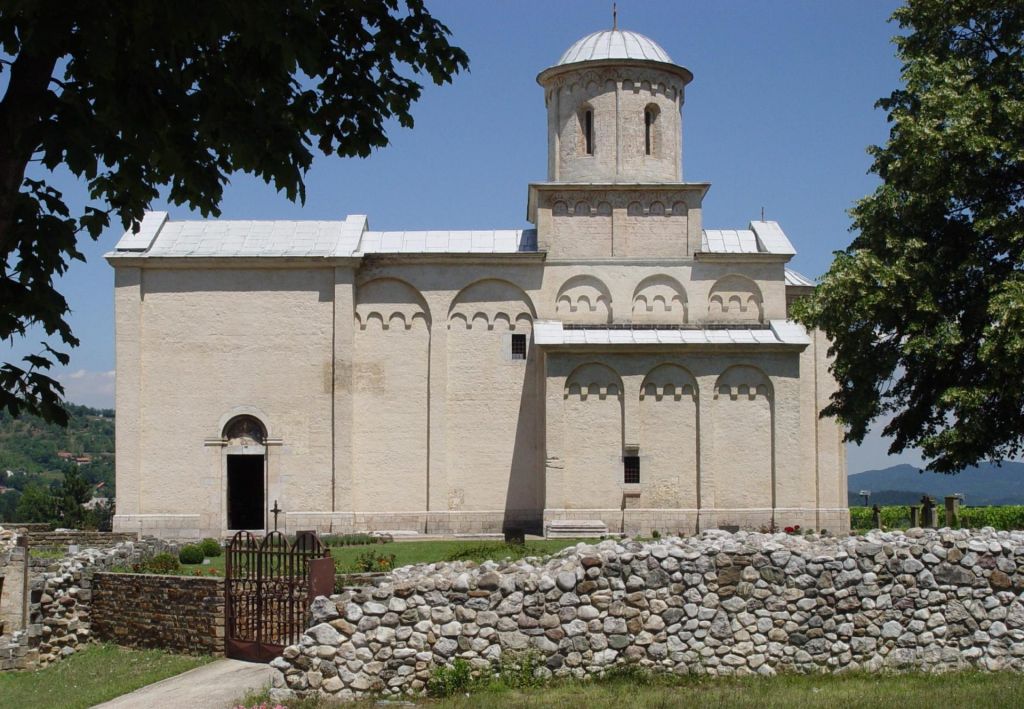
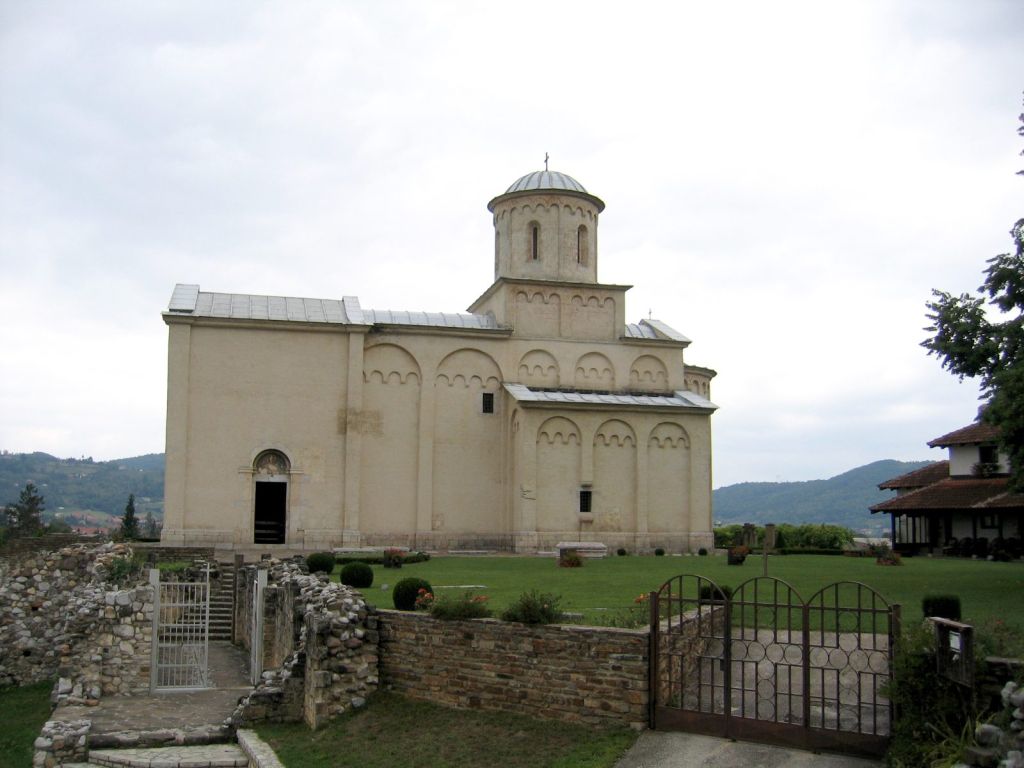
St Achillius Church
The church is dedicated to St Achillius and appears under several names in visitor material, including Saint Achilleos Church and the Serbian Crkva Svetog Ahilija. Its importance is not confined to one image or one ruler: the building carried religious, institutional and artistic meanings at the same site. That layered identity changes how the visit should be approached. Rather than using the church as a background to an Arilje town walk, pause over the relationship between dedication, patronage and painting. The result is a focused encounter with a medieval monument whose historical functions can be read before any uncertain local tradition is added.
King Dragutin’s medieval foundation at St Achillius Church
King Dragutin provides the firm royal frame for the church. Institutional accounts associate the foundation with him and place it in the thirteenth century, when royal endowments joined worship, dynastic memory and public authority in a single building. That context matters because it prevents the architecture from becoming an isolated style label. The patronage belonged to a political and devotional landscape in which a church could express both personal piety and the order of a medieval state.
No exact construction sequence should be reconstructed from the available visitor material. It supports the ruler, century and foundation context, but not a room-by-room building chronology. Read the royal connection as the starting point for the monument, not as permission to fill documentary gaps with a precise date or an assumed nearby palace.
St Achillius Church and its episcopal role
The church also belonged to an episcopal setting. That role gives the building an institutional dimension beyond royal patronage: it was connected with the organisation of church authority and not simply conceived as a commemorative object. For a visitor, this is the bridge between the foundation story and the painted interior. Images, dedication and liturgical space operated within a living ecclesiastical framework.
The available accounts do not provide enough detail for a complete administrative chronology, and their traditions concerning the arrival of relics do not align. It is therefore more accurate to recognise the bishopric context without forcing those traditions into a single sequence. This distinction preserves what is documented while leaving disputed timing unresolved.
Recognising Raška-style architecture at St Achillius Church
Raška architecture is the church’s primary architectural frame, but the label is more useful as a way of reading than as a checklist of unsupported details. In medieval Serbian church architecture, the Raška tradition is associated with a dialogue between Byzantine concepts of sacred interior space and Romanesque influence on external treatment. St Achillius belongs within that broader artistic current.
The church profiles used for this guide classify the building as Raška style but do not supply measurements, a complete façade survey or a phase-by-phase construction record. Look first at how the building presents a unified sacred form, then consider how exterior and interior belong to related traditions. Avoid assigning every visible feature to a named phase without specialist interpretation. The classification is established; a complete architectural inventory is not.
Late-thirteenth-century fresco painting at St Achillius Church
The paintings bring the church’s historical roles into visual form. They are identified as late-thirteenth-century frescoes, placing them close to the period of the royal foundation rather than treating them as a later decorative layer without context. Their value for the traveller lies in the way architecture and image were designed to be understood together: the building created the sacred setting, while the painted programme articulated figures, narratives and religious meaning within it.
A modern condition report is not available in the visitor material used here. Do not assume that every scene is equally visible, illuminated or accessible, and do not infer conservation quality from promotional photographs. If the interior is open, give your eyes time to adjust and use any interpretation available locally before trying to identify individual figures. That slower approach is more reliable than arriving with a fixed list of scenes that may not be readily legible.
Gabriel and the Blue Angel of Arilje
The named image that gives St Achillius Church a distinct place in Serbian fresco travel is Gabriel, known in Arilje as the Blue Angel or Ariljski anđeo. The useful point is identification rather than ranking: it is a depiction of the archangel within Arilje’s late-thirteenth-century painted ensemble. The name helps English-speaking visitors search for the work, but it should not replace attention to the wider programme around it.
The Blue Angel of Arilje is not the White Angel associated with Mileševa Monastery and its White Angel fresco. They belong to different churches and different visual contexts. Keeping the two separate makes a regional fresco journey more coherent and avoids reducing medieval painting in western Serbia to interchangeable angel images.
Connecting St Achillius Church to a Western Serbia cultural journey
St Achillius works well as one carefully read monument within Western Serbia’s mountain and heritage routes, but the church should retain its own time rather than becoming a hurried stop between larger destinations. Arilje provides the architectural and fresco subject; the broader region supplies comparisons in royal patronage, monastic institutions and medieval painting.
The Užice travel guide is useful for understanding a larger regional base, although no short transfer time or fixed public-transport connection to the church is established here. Build the route around confirmed road or bus information for the travel date. When extending the art theme, choose comparisons for a reason: Mileševa for a different angel image, Žiča for ecclesiastical authority and Studenica for the wider Raška architectural tradition.
Interior access and respectful visits at St Achillius Church
Treat St Achillius as an independently arranged church visit, not as a scheduled attraction with a guaranteed tour. A current opening window, admission price, service timetable, formal guided programme, tour duration, reservation rule and online booking link are not published in the checked institutional material. No email contact was identified. The Žiča Eparchy directory lists Bojan Milošević as rector; travellers can call the published rector contact to ask whether interior access is possible on the intended day. The official Žiča Eparchy directory for the Požega-Arilje deanery is the appropriate place to recheck the contact.
Photography permission and a step-free route are also not established. Ask before photographing frescoes, keep voices low, silence phones and do not cross liturgical barriers. If worship is taking place, allow the service to determine where visitors may stand and whether sightseeing is appropriate. A scarf or other special garment is not documented as a formal visitor requirement, but clothing suitable for an active Orthodox church is the cautious choice.
Sources and last checked
Sources cross-checked for this guide:
Last checked: 22 November 2026. Written and reviewed by the editorial team led by Patrick, and fact-checked against the official sources listed above.
History, tradition and unresolved interpretation at St Achillius Church
The church’s story is clearer when established descriptions, religious tradition and unresolved interpretation are kept in separate categories.
The shared account provides the dependable framework for reading the monument.
- Foundation
- Associated with King Dragutin in the thirteenth century
- Architectural identity
- Classified as Raška style
- Paintings
- Placed in the late thirteenth century
- Named image
- Gabriel, known as the Blue Angel
The presence of a tradition does not settle its date.
- Status
- Presented as belief or tradition
- Chronology
- Institutional accounts do not align
- Editorial treatment
- No single arrival date is asserted
A suggested royal setting should not be presented as confirmed archaeology.
- Claim type
- Interpretive assumption
- Verified location
- Not established in the reviewed church accounts
- Visitor takeaway
- Keep the church itself at the centre of the visit
These categories prevent later tradition or local assumption from being merged silently into the documented medieval framework.
Four churches for understanding St Achillius in context
These places frame different aspects of medieval church architecture, authority and fresco painting. Hours and prices are marked as unpublished where the evidence assembled for this route does not verify current operations.
Royal foundation and the Blue Angel
The central subject of the route, combining King Dragutin’s patronage, an episcopal setting, Raška classification and late-thirteenth-century painting.
A separate fresco context for the White Angel
Use Mileševa to distinguish its White Angel from Gabriel at Arilje rather than treating the two images as versions of the same work.
Ecclesiastical authority and medieval architecture
Žiča provides broader context for the relationship between church buildings, institutional authority and the development of Serbian medieval sacred architecture.
Context for the Raška architectural tradition
Studenica helps place the Raška synthesis of Byzantine spatial ideas and Romanesque exterior influence within a wider architectural history.