Block 21, Novi Beograd, Belgrade

The Mäander-Wohnblock is a long residential building in Novi Beograd's Block 21. Visitors usually come to understand New Belgrade's postwar urban form, photograph the building's extended meander-like line, and connect it with the district's broader modernist landscape. It is best approached as an architectural stop rather than a classic tourist attraction.
The Mäander-Wohnblock stands in Block 21 in Novi Beograd, the planned postwar part of Belgrade built as a system of large housing blocks and open spaces. The structure measures 972.5 meters in length and is described as the longest residential building in the former Yugoslavia. Its line bends through the block instead of sitting as a straight slab, which is what gives it the meander name. The setting is open, wide, and strongly urban, with the scale of the building shaped by roads, housing, and the larger New Belgrade grid. For visitors, the place feels calm, functional, and closely tied to architectural history rather than leisure tourism. Novi Beograd Travel Guide gives the broader district context.
The speciality here is the residential meander itself: a very long housing block shaped to fit the logic of New Belgrade's superblocks. That makes it different from a single landmark tower or a compact old-quarter street. Instead of one front and one back, the building reads as a continuous urban edge with repeated entrances, balconies, and a steady horizontal rhythm. Its interest comes from scale, repetition, and planning, not ornament. If you are already exploring modernist Belgrade, it connects naturally with the Palace of Serbia as another key New Belgrade modernist reference point.
Because it sits in a residential block, the best way to experience it is by walking along the perimeter and observing how the building organizes space around it. The result is practical architecture rather than spectacle, which is exactly why it matters to people interested in the city's 20th-century design story.
From the Ušće area or the Palace of Serbia side, the easiest approach is a short walk through Block 21 on flat pavement; allow 10 to 20 minutes depending on your starting point and how much of the block you want to see. Public transport in Novi Beograd is usually easiest from the main district corridors rather than the building itself. Bus lines 16, 17, 68, 70, 74, 75, 77, 84, 88, and 610 all serve parts of Novi Beograd, with the nearest stop depending on your approach. Taxi fares within Novi Beograd are usually modest, and a short ride from central Belgrade is generally the simplest option if you are not already in the district. Parking is possible along the surrounding streets, but spaces can be limited during working hours.
Morning and late afternoon are the most practical times, when the light is better for seeing the building's long horizontal rhythm. Weekdays feel more ordinary because the area functions as a residential environment, while weekends are quieter for walking. Spring and autumn are the most comfortable seasons for a longer urban walk in Novi Beograd. No reservation is needed to view the exterior, but you should avoid times when you are likely to be crossing traffic-heavy streets on foot.
This is a lived-in residential building, so the atmosphere is quiet, practical, and not set up like a museum. Dress code is casual, though modest behavior matters because people live here. Accessibility is better than in many older urban areas because the streets are broad and mostly flat, but crossing large roads can still be inconvenient. Noise is usually low outside peak traffic periods. Families can visit easily if they are interested in architecture, but there are no visitor services, toilets, or formal ticketing. The main thing to bring is patience for observation, not a checklist of attractions.
Block 21 in Novi Beograd, Belgrade.
These nearby or connected places help explain the district's scale, planning, and architectural character.
Mäander-Wohnblock
The main subject: a 972.5-meter residential block with a meandering line through Block 21.
Best for seeing how New Belgrade housing was planned at a very large scale.
Palace of Serbia
A major modernist government complex in Novi Beograd.
Useful as a second stop for understanding the district's postwar civic architecture.
Novi Beograd Travel Guide
District guide to blocks, riverside walks, and modernist landmarks.
A practical base for planning a walk around Block 21 and the surrounding area.
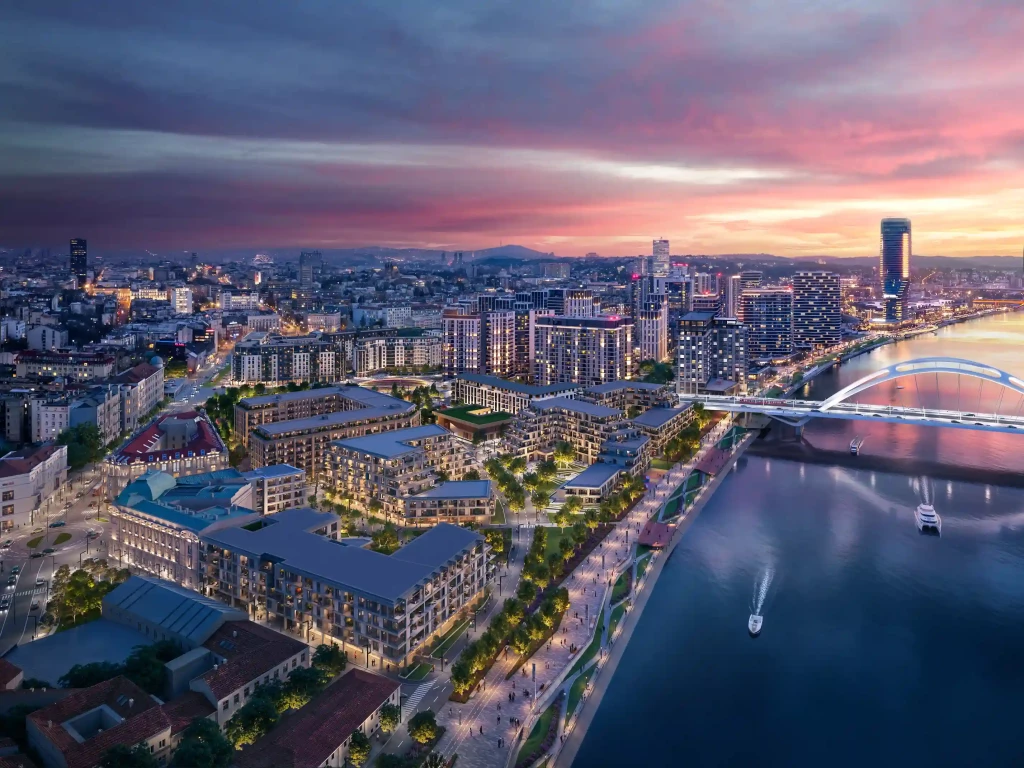
Belgrade Waterfront
A river-edge redevelopment area across the Sava side of central Belgrade.
Useful for comparing older planned New Belgrade space with newer riverfront development.
Block 21, Novi Beograd, Belgrade
Palace of Serbia
Meandering residential modernism
Free to view from public streets
Morning or late afternoon
No
No formal visitor program is listed. Most travelers view it from the outside as part of a walking route through Block 21.
It is notable for its 972.5-meter length and its role in New Belgrade's postwar housing and planning story.
About 20 to 40 minutes is enough for a focused exterior visit, longer if you want to walk the block and study the surrounding urban grid.
Yes, but it is easier if you already are in Novi Beograd. Bus routes serving the district include 16, 17, 68, 70, 74, 75, 77, 84, 88, and 610.
Yes. The Palace of Serbia is the most natural companion, and the broader Novi Beograd district gives the best context for the building.
Use this stop as part of a wider walk through New Belgrade's blocks, civic buildings, and river-adjacent streets.